The wind around North Texas early this week was really wild. On Sunday and Monday, the wind blew very hard out of the South. I went for a 7 mile out-and-back run Monday afternoon and made the mistake of running with the wind at my back for 3.5 miles "out". On the return to my house, I literally thought the wind was going to lift me off of the ground. It slowed me to a snail's pace for the second half of the run. Here are some tips for the next run you do on a windy day:
1. If you must do an out and back run, start by running in to the wind. Then, the trip back will seem much easier.
2. Have your spouse or friend drive you for your desired run distance into the wind and do your entire run with the wind at your back.
3. Make it into a workout. Run into the wind for 1 minute hard, then turn around and run with the wind for 2 minutes.
4. Go to a track and do an interval or repetition session. An example: repeat 200s (run one with the wind at your back, then jog diagonally across the field back to the start).
5. Dust off the old treadmill. Personally, I hate running on treadmills but with Monday's wind gusts the treadmill would have been a relief.
6. Tuck your chin to your chest, grit your teeth, and suck it up! The wind only makes you stronger!
Wednesday, March 25, 2009

Sunday, March 8, 2009
Track is Back!!
I love the month of March! Daylight savings gives us more outdoor time in the evening, flowers and trees are blooming, the weather is usually really nice, and track season kicks off. Yesterday, the boys at Krum had their first track meet at Iowa Park. I love coaching track because I get to see so many different types of kids compete--the throwers, jumpers, sprinters, hurdlers and distance runners.
Here are my top 10 favorite track and field memories:
10. Seeing Forth Worth O.D. Wyatt set the national high school record in the 400 Relay (39.76) at the 1998 State Track Meet.
9. Watching Logan Bowman (a Krum runner I coached) win the 1600 and 3200 at the Region II-2A meet in Stephenville (2005).
8. Attending the Penn Relays as a Freshman at Rice in 1999 and running on the 4x800 relay.
7. Setting the Rice school record and NCAA provisional qualifying mark in the Distance Medley Relay at the Notre Dame Last Chance Meet. I ran the lead off leg (1200 meters).
6. As a Senior at Childress High School, beating Vernon High School to win the 4x400 District Championship in 3:21. My teammates were Jerome Jackson, Eric Green, and Norman Drew (Grasshopper).
5. Seeing Luke Inman puke up his mexican food after splitting a 50 on the 4x400 at the Amarillo Relays. Luke was added to the relay after another runner was injured. He had gone to eat lunch at a mexican place with his mother only an hour before. We finished 3rd in 3:24--this was the first time I realized we could have a really good relay.
4. Running a 3:46 PR in the 1500 at the Texas Invitational 2001. Clyde Colenso of SMU rabbitted the race with perfect pacing. He completed the entire race (and made it look easy) to win in 3:43. Another SMU Mustang, Dalibor Balgac, finished 2nd with me close behind.
3. Attending the World Track & Field Championships in Edmonton, Canada in 2001. It was truly amazing to see the world's finest track athletes compete at their highest.
2. Seeing Krum Sophomore Coleby Borchardt win the Region II-2A 800 title in dramatic fashion and a personal best time of 1:57.17 (not bad for a Sophomore, right?).
1. Winning the 1998 Class 3A 800 for Childress. I can still remember every detail of that race.
I can't wait to add to the memories this track season!!
Sunday, March 1, 2009
Cowtown Recap


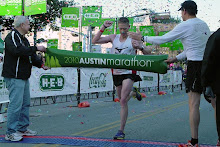
I checked the weather forecast periodically throughout the week last week, and as Saturday approached, I was dreading the WIND. Sure enough I woke up at 4:45 a.m. Saturday morning to a howling North wind. I arrived at the race with my friends Tod Tieszen, Paul Polk and Shane Pierce at about 6:30. (See a picture of me and Shane above.) It was awesome riding to the race with those guys--a race is always more fun when you do it with a group of friends.
Before heading to the start line, Tod led the four of us in prayer. Despite the cold, I decided to run with just a singlet, shorts, hat and glove. At the start, a group of half-marathoners jumped out to the early lead. I quickly settled in behind this lead group. At about the 6 mile mark this group started to break apart, and the eventual winner took a commanding lead. I stayed close behind him until the half-marathon and marathon courses split at the 8 mile marker.
My goal time coming in to the race was 2:28; a 5:40 per mile pace. From the beginning of the race, I kept a plus/minus count of how close I was to 5:40 pace. By the half way point, I already had over 2 minutes in the bank. I took my first POWERBAR gel pack at around mile 15 and my seconde at mile 21. By mile 23, I had over 3 1/2 minutes in the bank, and so all I needed to do was maintain in the last 3 miles to exceed my expectations.
At mile 24, I merged with the finish of the half-marathon course. Many of those runners were cheering me on as I passed. As I made the final turn and had the finish line in my sights, I felt a rush of adrenaline. The police escort was bottlenecked by waves of half-marathon finishers, so I passed him up and gave my best effort to sprint to the finish. I crossed the tape in 2:25:13, my 3rd best time ever (over 3 minutes faster than my goal time).
My splits are below:
5:30, 5:45, 5:31, 5:19, 4:34 (this one and the next had to have been mis-marked), 6:19, 5:30, 5:30, 10:48 (I missed the 9 mile marker so this is a 2 mile split), 5:35, 5:27, 5:46 (this would be my slowest mile), 5:33, 5:30, 5:29, 5:41, 5:41, 5:32, 5:40, 5:20, 5:36, 5:28, 18:03 (at this point I was so excited about winning my 3rd Cowtown that I quit looking for mile markers and just ran)--2:25:13
Thursday, February 19, 2009
1 Week to Cowtown
According to the Cowtown website at the moment I am writing this blog entry, there are only 8 days, 11 hours and 24 minutes left to race time. I am excited and ready for the race to be here. Marathon training is a very long process, and it takes a lot out of you. By this point in my training, I am so ready to just race--I feel as though I have been training forever. I wonder if other marathoners feel the same way.
My training has been pretty good, although I did not get the same kind of high mileage in as I did when training for Steamtown. I have managed a tempo and interval session each week as well as a long run of 18-22 miles. This week, my legs have been pretty tired, and it made me question whether or not I was backing off enough. I have learned to listen to my body when race time approaches. Here are some signs you may need to back off in those last crucial weeks of training:
1. Take your pulse in the morning--take the day off or easy if your resting heart rate is abnormally higher than usual
2. If you wake up and feel exhausted, go back to SLEEP (at least for one day, it won't hurt you to sleep in and skip that morning run)
3. If your legs feel heavy and/or tired while walking--Take a load off and prop your feet up (elevate the legs)
4. Sharp pain of any kind anywhere can indicate possible injury; this late in the game, don't risk it and take the day off.
5. If within the first 10-20 minutes of your run your legs begin to feel tired, just stop!!
6. If you have any mental doubts at all about doing a run in the last week of training (i.e., you think doing a run might zap your legs for the race), then just don't run. THE HAY IS IN THE BARN!! Nothing you do in the last week of training is going to make you run faster.
8 Days, 11 hours and 10 minutes!!
Saturday, February 14, 2009
Happy Valentine's Day

My wife has many talents, and recently she has discovered a love for decorating cakes. This is her latest creation--a cookie cake for me! This is only her third cake to decorate, and I think she is already really good at it. Love you, Steph.
Monday, February 9, 2009
Lungs, Legs, Wheels and Thrills
Recently, I had someone ask me about my training philosophy (How do I go about training for distance racing?). Well, I have always had a fairly simple training approach, but I've never really had to explain it in simple terms to a non-runner. My philosophy follows very closely the training methods of legendary distance coach Arthur Lydiard. Lydiard believed the most "trainable" system was the aerobic system. He said you should spend most of your time just running miles and building endurance. You follow that up with training on hills to build power and strength in the legs, then you spend 4 weeks or so training your anaerobic system. Finally, you work on speed and rest for the big race.
Well, Lydiard was really good at explaining the science behind his training method, but I like to sum it all up with this phrase "Lungs, legs, wheels, and thrills"! I believe that simple phrase (in that order) correctly summarizes the proper phases of training.
LUNGS--The first thing you do in distance training is build up your lungs. Distance running is a very aerobic activity, so you have to run lots of miles with the purpose of expanding your aerobic capacity. For 10-12 weeks, you should just run mileage at a comfortable pace, increasing your mileage each week. This phase of training is the foundation for everything you will do for the rest of the season.
LEGS--With the proper foundation, you can begin to tackle the next challenge of distance running, anaerobic capacity. Everyone that has ever run hard for an extended period knows that eventually your legs begin to feel heavy, like lead. Well, in order to train your legs for this part of the race, you have to train at your lactate threshold (this is the point where lactic acid begins to accumulate in your blood stream AND it is why your legs begin to feel heavy). So, what does that mean in terms of training? Intervals and Fartlek training.
WHEELS--When I was a kid, we would say that someone who was really fast, "had wheels". They were so fast, it was as if they had wheels for feet. The next phase in training is developing the wheels, the speed. You should always work on speed to some degree, but the last few weeks of training should be largely devoted to fine tuning your turnover. Speedwork is short bouts of fast running with lots of rest. Volume of running should be kept low.
THRILLS--This is the easy part of the training. The last week (or more for longer races) should mostly be active recovery. If your legs ever feel tired during any of these workouts, you probably take the day off. Intensity should be very low, as should volume. There is a scene from the running movie Without Limits where Coach Bill Bowerman gave his star, Steve Prefontaine, a very short workout the day before the NCAA Championships. Prefontaine complained about the workout's lack of intensity, and the old coach replied, "The hay is in the barn." At this point in your training, you are ready. Nothing you do in this week will help you on race day (but you could certainly do damage to your legs by running too hard). So, you just need to rest, wait for the race, and dream about the thrill of victory.
Monday, February 2, 2009
Conquer the Long Run
When training for a marathon, it is essential that you get several quality long runs under your belt. In training for past marathons, I dreaded doing the weekly long run. They take so much time and can get quite boring. However, for the last two marathons, I have changed my approach to the long run, and I have actually learned to enjoy them. Here are some tips for your next one:
1. If possible, run with a partner. Running is always better if you have someone beside you.
2. If you don't have a running partner, listen to an IPOD. I used to say that I would never listen to music when I ran (I thought I was too good for that). But, I have learned that music can help pass the time. And, music can also help you establish your running rythm.
3. Choose a point-to-point course. I always enjoy starting from home and ending up in another town. Have your spouse, friend or family member come and pick you up. My favorite is starting in Krum and finishing in Corinth.
4. Run somewhere new. Every once in a while I will make a short drive over to the Greenbelt trail on Hwy. 380 for a long run. The new scenery through the trails is just enough to refresh my long run.
5. Make an event out of it. Run to a breakfast place, and have your spouse or a buddy meet you there. Replenish all those calories you burned with pancakes and bacon.
6. Set up water along your route. This is one I need to do more often. Practice drinking at certain mile markers and establish a drink plan for your race.
7. Use a GPS watch. I'm a big believer in these now for long runs. They can monitor your pace, distance, time, Heart Rate, and even your calories burned. Truly awesome!!
8. Mentally and physically prepare for your long run. Treat it like it is the real deal. Decide on a time to do your long run, and do not change it. Eat good carbs the night before your run and a healthy breakfast/snack before you start.
9. Reward yourself after you are done. Completing a long run is a true accomplishment. Kick back and relax for the rest of the day--you deserve it!
Subscribe to:
Posts (Atom)